Friday, May 25, 2012

SETI Contact Conference 2012 Talk


SETI Contact Conference 2012
March 31
Sunnyvale California

Good Afternoon!  And ALOHA!
Dr. John C. Lilly’s book, Communication Between  Man & Dolphin fell into my hands while living on Maui in 1978.  Reading it decided my career.  I knew I wanted to talk with dolphins!
I am learning to communicate with inhabitants of Planet Ocean – with a species in so many ways completely different than ours, no hands, no legs, not speaking nor breathing from the mouth, living in a weightless 3D environment – and yet, CETACEANS, particularly dolphins, are extremely relatable.
In 1980, John Lilly opened a lab at Marine World/Africa USA, in Redwood City, not far from where I was living in Cupertino.  At Marine World, I found that Lilly had yet to get his dolphins, but there was a petting pool open to the public.  I returned every weekend, played with the three dolphins, and made friends with Terry, Gordo, & Spray.          
Terry especially allowed an amazing level of play.  I held her tail and we danced—I stretched and spun and plunged her from over the tank wall.  We embraced, I kissed and licked her skin. 
   
Terry taught me grace in dancing with a dolphin.  She offered me amazing trust, with complete surrender to my touch and moves. I hated leaving at night, felt she never belonged in captivity, and wished to take her away to the sea.

A research  team began studies and the pool was closed to public interaction.  I was dismayed, but the lead investigator immediately asked me to join her work on a bi-lateral communication study.

As a volunteer, I worked with my own research subject, Terry.  I would come early and stay late to enjoy free play with the dolphins once again.  Terry continued to teach me what it meant to be a dolphin.
At Contact 2010, the title to my talk was Who’s Testing Whom?  I told the story of “20 Wrongs in a Row” in which Terry found out what was acceptable as touching the target -- by almost touching the target 20x’s in a row. Various parts of her body came very close without touching, she even tried squirting water at the target, but my response was No Touch/ Incorrect.  Terry tested my perceptions and definition of “Touch” and "Correct."
 
I became a diver for the park, cleaning all the tanks, including the show tank.  There I met the alpha female Shiloh, the punk Bayou, shy Schooner, sweet Stormy, and the 20' pilot whale Koko.  The show dolphins tested my trust of them over and over, in mean-girl games.  They rewarded me for trusting them not to hurt me, although they did battle with the divers quite often. 
    
Trust is an important issue in dolphin relations.

Dolphins in the wild also test our perceptions and play trust games.

Pilot Whales Rise

Four impressive pilot whales traveling slowly below the surface seemed not to mind at all as three women swam above them.  They could have easily moved out from under us, but instead allowed our company as they glided between breaths for over five minutes before coming up for air just in front of us. The one to the left is definately a male, the one directly below a male as well and the third, to the right of me, a subadult or possibly female.  Another group was made up of several youngsters, with surely females nearby. 10 or more pilots in this pod.
Pilot whales are not considered endangered, although of course we want to preserve their numbers and protect every whale in our oceans.  We have no idea who they really are!  They are found regularly several miles off the Kona coast.


Pilot whales die in great numbers, beaching themselves and at human hands.  Although my friend, videographer Lee Tepley, filmed a pilot whale dragging a woman underwater with his teeth, in thousands of other encounters along the Kona coast pilot whales have not harmed people.  Cetaceans have great respect for us.  They deserve great respect given to them.

Much aloha,
Roberta Goodman
Wild Dolphin Swims Hawaii
Kailua Kona

Tuesday, March 13, 2012

SETI Contact Conference in Sunnyvale March 30-April 1


Wild Dolphin Studies in Hawaii as a Model for Future Encounters!

I'm looking forward to attending and speaking at the Contact conference at the end of March!  In 2010 I met the nicest group of people giving great presentations, and was well received for my talk on dolphin communication experiments:  Who's Testing Whom? This year I will continue proposing my research with dolphins as applicable to future interactions with other worldly beings in a storytelling format.
Hope to see you there!
www.contact-conference.com

Roberta Goodman
Wild Dolphin Swims Hawaii

Upcoming Interstellar Sessions

by Paul Gilster on March 12, 2012
It’s shaping up to be an interesting week. I want to get to the recent Kepler data release, and also to the antimatter news from CERN, and I also want to talk about everything from decelerating an interstellar craft to models of expansion into the galaxy a la Frank Tipler. [And thanks to Centauri Dreams reader Eric Goldstein for reminding me of the upcoming WISE data release on the 14th!]. For today, though, let’s look at two upcoming conferences, especially since I’m running behind in getting to the first of them, the CONTACT 2012 gathering, which is coming up right away.

The full title of this one is CONTACT: Cultures of the Imagination, and it’s a meeting with a rich history. Back in 1979, Jim Funaro was teaching a course in anthropology at Cabrillo College (Aptos, CA) that used science fiction as a vector into the scientific issues his course raised. The course allowed students to go to work creating cultures and, in a game-like simulation, to explore how the fictional societies interacted with each other. By 1983, Funaro was able to use this ‘laboratory experiment’ in anthropology as the main event of the first CONTACT meeting, set up to be a national academic conference bringing scientists, artists and writers together.
Interdisciplinary Insights into ETI
When Funaro founded CONTACT, his goal was to encourage interdisciplinary thinking, which must have been much in the air back in 1983, considering that this was also the year of the storied Interstellar Migration and the Human Experience conference held at Los Alamos. The latter ranged from astrophysics to sociology, psychology and history and probed how emerging technologies would affect future human expansion into the cosmos. Meanwhile, CONTACT had been energized by Funaro’s interactions with science fiction writer Frank Herbert, whose classic novel Dune was one of the books used in his class as an example of a credible created culture.
How Funaro lured other writers and scientists into CONTACT is told on the conference’s website. In any case, writers like Michael Bishop, Larry Niven, John Brunner and C.J. Cherryh soon became involved, and Funaro worked with artist Joel Hagen to launch the first world-building project. Although the first CONTACT conference ran in April of 1983 (in Santa Cruz), the culture-building simulations of what Funaro called the ‘Bateson Project’ (after anthropologist Gregory Bateson) were a success, and anthropology as simulation/performance art was established, while the original simulation idea was renamed “Cultures of the Imagination.”
Funaro calls CONTACT III “the first time it worked,” noting that this was the conference where lessons learned from the first two conferences were first implemented. The cross-disciplinary nature of the proceedings is easily seen in his account of building the pre-conference package:
Poul Anderson gave us a planet, Ophelia, with its primary and solar system… We then sent the planetary specifications to C. J. Cherryh, who suggested the Mossback [the resident alien of the planet] and provided us with its basic design. Next, Larry Niven elaborated on this alien, contributed other species for the ecology and explained the conditions that the human team would face on this world. Finally, Joel Hagen produced some sketches of the critters. This “homework” was then distributed to all the guests several weeks before the conference.
Specialized teams at the conference then went to work to develop the world and its culture, and sequential workshops developed the key issues. Role-playing developed and became a major tool. Funaro acknowledges that such simulations are artificial and limited:
But, like the real intercultural contacts that anthropologists have been participating in for more than a century here on our home planet, the interaction was unrehearsed, proceeded carefully from known behavioral and ethnographic methodologies towards consistent and ethical choices of action, and provided at least a possible model for developing a protocol for an extraterrestrial encounter. And the value of spontaneous role-playing in enhancing the effectiveness of the simulation was convincingly (however unexpectedly) demonstrated. It has been an essential part of COTI forever after.
Frank Drake will be the keynote speaker at CONTACT 2012 at the Domain Hotel in Sunnyvale (CA), with conference sessions running from March 30 to April 1. You can see the full schedule along with abstracts of the talks here. Among the offerings I note in particular Kathryn Denning on our expectations in interstellar contact (“Unboxing Pandora”), Albert Harrison on Russian cosmism, a philosophical movement that emerged around 1900 and influenced our modern views of space exploration, and Seth Shostak’s sure to be controversial “Broadcasting into Space: Recipe for Catastrophe?” If that last one doesn’t raise the temperature in the room, nothing will.

Whale Escorts Spinner Dolphins on a Wild Swim

Mantas, Dolphins, Whales!


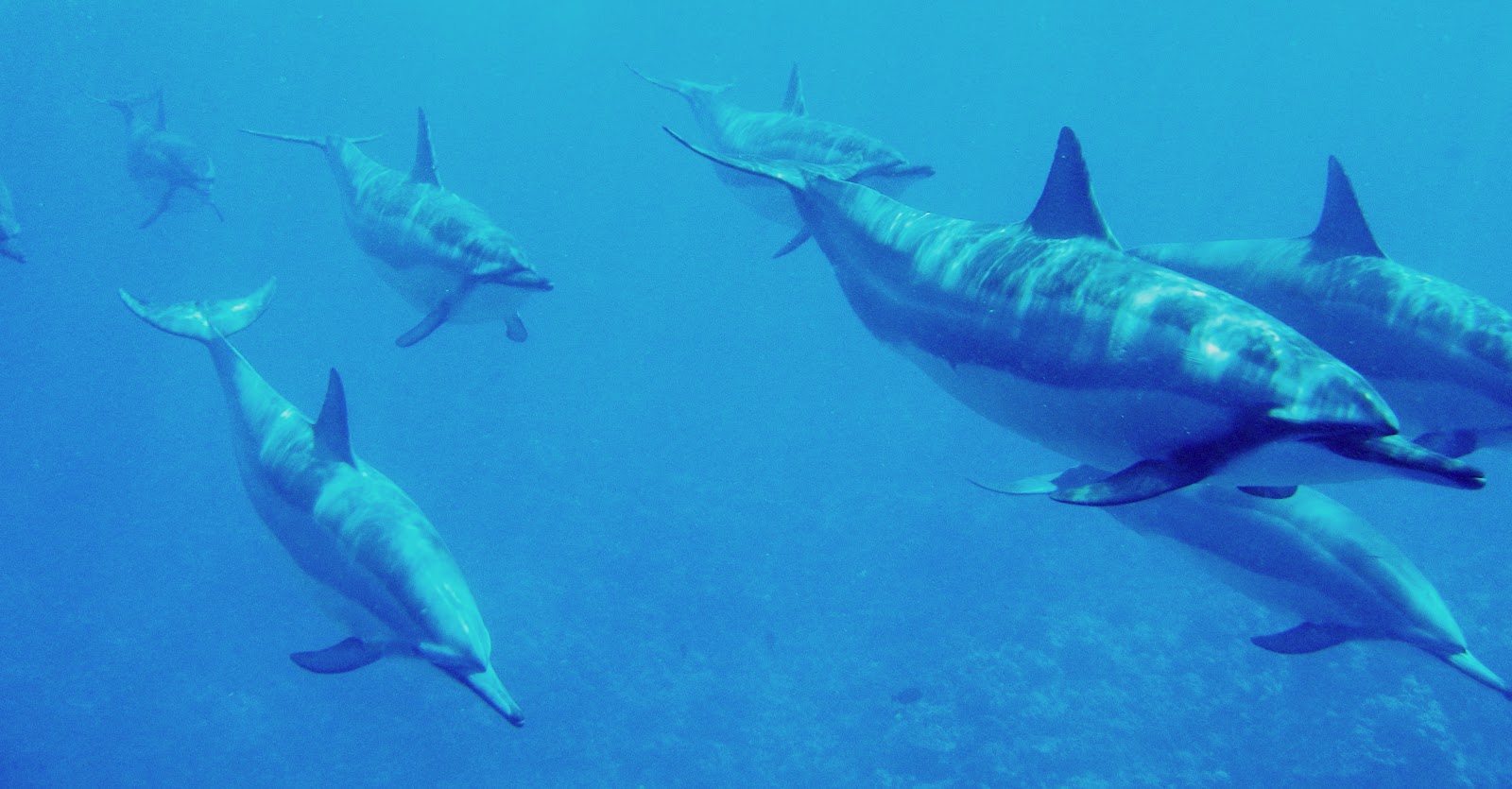
After climbing over large swells to get into the bay at Makalewena, the water was quiet and clear.  Mom-baby-escorts and pairs of humpbacks were scattered around nearby.  Mantas hovered over the reef.  A small pod of 9 spinner dolphins circled around and under us when we slipped into the water.  A piercing whistle was repeated over and over.  It became apparent they were waiting for something, when the pod of around 200 showed up heading towards us.  The dolphins streamed by and somewhere in their midst was a single young whale.
They were on the move and all we could was watch them
fly by. 


After they pass, we board the boat and head out to watch an active group, which began with a breach right in front of us.  A couple of males and a female, one male slapping the water with his enormous pectoral fin over and over.  Fifteen minutes or so and it was over, perhaps the female made her choice.


Onward to the manta reef!  We got in with Koie Ray, one of our large females.  She's easy to identify as one of her cephalic fins has been amputated after being wrapped in fishing line. This 12' manta shows up very frequently during our nightime snorkel and dives with the feeding rays.  Koie joined the night snorkel with my group last night, along with 7 other mantas. 
200 dolphins passed right over the reef and the sandy shelf where the reef drops off.


On either side of us, right over the shallow reef and the sandy shelf about 30’ below.  At the end of the stream of dolphins, a last group escorts the young whale along the bottom, surprising us and Koie too! I wish this imbed would show the video here.... but you can also find it at  https://vimeo.com/38416881


<iframe src="http://player.vimeo.com/video/38416881?title=0&amp;byline=0&amp;portrait=0" width="343" height="193" frameborder="0" webkitAllowFullScreen mozallowfullscreen allowFullScreen></iframe>

I added the sound track. We commonly hear the amazing song of the humpbacks while snorkeling with manta rays and dolphins. My camera didnt pick up the ambient sounds well, so I added this recording we made while in a pod of dolphins and with whalesong in the background. The dolphin sounds dont really fit the scene, as they were sonaring and squawking around our hydrophone and the dolphins in the video were quite quiet with some sonar and whistles.
Dolphin Dreams!
Roberta Goodman